Oct 13 2026
September market update: Tough month for conservative investors
September was a challenging month for conservative investors, who faced headwinds as global government bond yields climbed to their highest levels since 2007.
While higher bond yields can be good news for people investing new money, they typically cause existing bonds to fall in value. As a result, bond markets delivered negative returns during the month.
Why are bond yields rising?
Three key factors are behind these rising bond yields.
1. Inflation remains stubbornly high
Inflation remains a concern across much of the world. Oil prices continue to play a role in this, with Brent crude rising back above US$100 a barrel this month following drone attacks on Saudi Arabia's East-West pipeline. This ongoing uncertainty around tensions with Iran has added to concerns about future energy prices.
When energy costs rise, inflation often follows, making it harder for central banks to bring inflation back to their target ranges.
2. Central banks are raising interest rates – or signalling that way
To combat inflation, many central banks have either raised interest rates or signalled that further increases may be needed.
Higher official interest rates generally flow through to bond markets, pushing yields higher across the board.
3. Governments are borrowing more
Governments worldwide continue to run large deficits and borrow heavily. This means investors demand higher returns before lending money to governments, pushing bond yields higher.
In the United States, for example, the 10-year government bond is now yielding around 5.3%, its highest level since the Global Financial Crisis, while the 30-year bond is yielding about 5.6%, the highest since 2002.
Inflation and interest rates stay in focus
In the United States, inflation showed some signs of easing. The Federal Reserve's preferred inflation measure - known as the Personal Consumption Expenditures (PCE) index - increased 3.4% over the year to August, coming in lower than expected but still higher than the targeted 2%.
Despite this encouraging result, the US Federal Reserve raised interest rates by 0.25%, lifting the federal funds rate to between 3.75% and 4.00%.
In the United Kingdom, the Bank of England left interest rates untouched at 3.75%, although three committee members voted for another increase. UK inflation is above target too, with consumer prices rising 3.1% over the year to August.
Closer to home, New Zealand's economy continues to grow – albeit modestly. Gross Domestic Product (GDP) grew 0.2% during the June quarter, taking annual growth to 2.6%, the strongest pace since mid-2023. The Reserve Bank of New Zealand upped its Official Cash Rate by 0.25% to 2.75% in September.
What’s happening with AI now?
A meeting between US President Donald Trump and Chinese President Xi Jinping attracted plenty of attention during the month. Trade and artificial intelligence (AI) were big topics on the agenda.
AI remained a major focus for investors. Several leading AI executives warned that this game-changing technology needs stronger safeguards and slower development because of serious concerns about its potential risks. But it appears both the US and China are reluctant to impose heavy regulation, as both nations are racing to be the leaders in this sector – and regulation could impede that. The US says it favours the sector regulating itself.
In the United Kingdom, Prime Minister Andy Burnham has raised the possibility of rejoining the European Union (back to Bremain?) and proposed changes to the State Pension guarantee from 2030. This plan would remove the earnings-growth component of the current pension ‘triple lock’, instead increasing pensions by inflation or 2.5%, whichever is higher. He has also signalled that tax increases may be on the table.
Across the Tasman, inflation remains stubbornly high in Australia. Consumer prices rose 4.0% over the year to August, with the Reserve Bank of Australia increasing its cash rate by 0.25% to 4.6%.
These higher Australian interest rates have strengthened the Australian dollar against New Zealand’s dollar. One AUD now buys around NZ$1.23. For those Kiwis heading to Australia for a holiday, your trip just got more expensive. But a Kiwi investor just got a boosted return on their unhedged AU equities (Lifetime’s AU equities are unhedged).
Sharemarkets holding up
While bond markets struggled in September, sharemarkets delivered mixed results.
In New Zealand, the NZX50 fell 0.6% during the month but is still up 4.1% over the past year.
Australia's ASX200 went down 3.2% in September and is down 0.7% over the year.
However, enthusiasm for AI and semiconductor companies helped support markets in the United States. The technology-heavy Nasdaq Composite index rose 1.9% during September; it’s up an impressive 18.5% over the past 12 months. Meanwhile, the S&P500 fell 0.5% during the month but remains up 14.4% over the year.
In the UK, the FTSE100 fell 2.0% during the month, but is up 13.4% over the year.
A redeeming feature was that the NZD fell 4.6% against the USD (and fell against all the major currencies). That meant that 0.5% fall in the S&P500 converted to a 4.1% return for an unhedged Kiwi investor. Everything has a flipside.
Chart of the month
Speaking of inflation…. Where does New Zealand rank when it comes to the cost of dining out? The answer might surprise you.
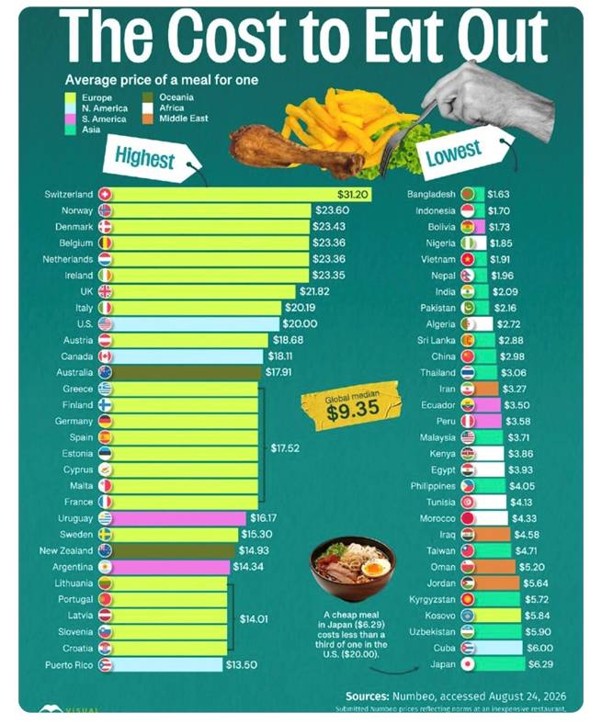
Source: VisualCapitalist.com